The Angles of Attack: Dialling In Camber and Toe for a French Hot Hatch on British Tarmac
There is a moment, usually midway through a damp B-road corner, when a French hot hatch feels like it is holding something back. The steering is precise enough, the body control is decent, but the front end is not quite biting and the rear is not quite helping. Often that is not a worn damper or a tired bush. It is the alignment.
Geometry is one of the few modifications that can change how a car behaves without adding a single horsepower. It is also one of the easiest things to get wrong. A set of numbers copied from a forum thread, intended for a smooth European circuit and semi-slick tyres, can make a road car nervous, chew through tyres and feel awful on the potholed stuff most of us actually drive.
This is not a set-and-forget job. It is a conversation between you, your car, your tyre choice and the roads you use.
Why factory settings are a compromise
Manufacturers build in understeer because it is safe. They also build in modest camber and toe settings because they want long tyre life, predictable stability and a car that behaves for every driver in every market. A Clio 182, a 205 GTi or a Megane RS left on factory geometry is not badly set up. It is set up for everyone, which means it is not set up for you.
The UK adds its own twist. Our B-roads are cambered, patched and frequently broken. Our motorways have lorry-worn lanes that pull a car around. A track day at Cadwell Park or Bedford Autodrome asks for something different again. The trick is finding a fast-road setup that gives you more front-end bite without making the car a handful on a wet A-road.
Fast-road figures that will not ruin the commute
Treat these as sensible starting points, not gospel. Every car is different, every driver has a different tolerance for nervousness, and tyre construction matters enormously.
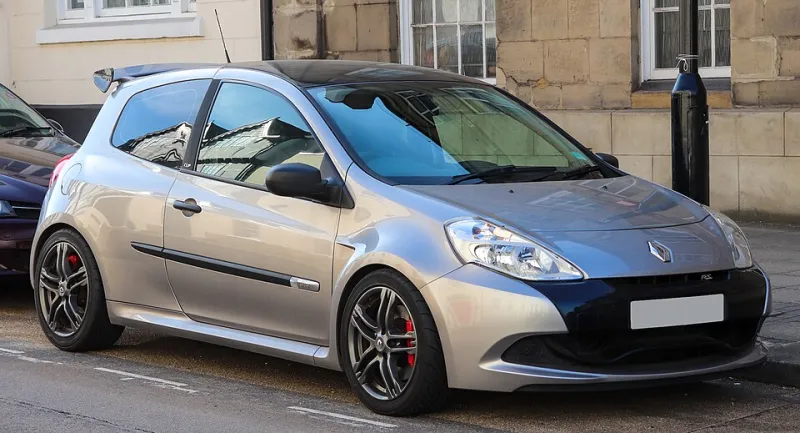
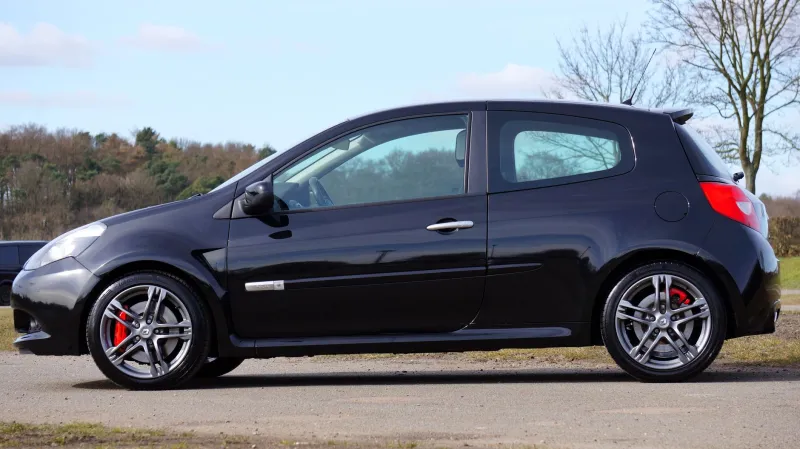
For a road-biased Clio 172, 182, 197 or 200, a common fast-road starting point is around -1.5° to -2.0° of front camber, with the rear left closer to -1.0° to -1.5° where adjustment exists. Front toe is often set near parallel, perhaps a few minutes toe-out in total if you want a sharper turn-in and can live with a little more tramlining. Rear toe-in of around 10 to 20 minutes total helps stability at speed.
A 205 GTi is a different beast. Front camber around -1.5° to -2.0° works well on a fast road car, with toe close to parallel. The rear beam is not adjustable in the usual sense, so unless you are fitting shims or a modified beam, you are working with what the factory gave you. That is fine. A well-sorted 205 on modest geometry is still one of the great UK B-road cars.
Megane RS models tend to respond well to a bit more front camber, often around -2.0° for fast road use, with rear toe-in kept sensible for high-speed stability. Do not chase aggressive numbers on a car that spends most of its life on the M25 and supermarket car parks.
Trackday geometry: more commitment, more compromise
For a track-focused car, the numbers get more serious. Front camber of -2.5° to -3.5° is common, depending on tyre, driver style and how much straight-line braking you are willing to sacrifice. Front toe-out of around 5 to 15 minutes total can help initial turn-in. Rear toe-in of 15 to 25 minutes total is a typical stability baseline.
The catch is that track geometry is exactly what it says on the tin. It works on a smooth circuit with consistent cambers and high grip. It can feel skittish on a wet, broken B-road. If your car is 80 percent road and 20 percent track, do not let a specialist talk you into a full race setup just because it looks good on a printout.
Bump steer, ride height and the lowered-car trap
Bump steer is the sneaky one. It describes how the steering changes as the suspension compresses and extends. Lower a car and you alter the angle of the steering arms relative to the rack. The result can be a car that wanders over crests, darts across camber changes and feels unpredictable under braking.
On a French hot hatch that has been lowered for looks or track clearance, bump steer should be part of the conversation. Ask whether the specialist can measure it, and whether correction is needed. On some cars, adjustable tie rod ends or bump steer correction kits are available. On others, the answer is to raise the ride height or accept a compromise.
This is also why slamming a car on cheap coilovers and then wondering why it feels awful is a false economy. Ride height, roll centres and geometry are linked. A specialist who understands French hatches will know where the sensible window is.
Tyre wear, potholes and the British compromise
Aggressive negative camber looks great on a spec sheet and terrible on the inner shoulder of your front tyres. If you do a lot of motorway miles, too much camber will wear the inside edge long before the rest of the tread is finished. Toe-out sharpens turn-in but can increase drag and tramlining. Rear toe-in is your friend for stability, but too much can scrub speed and tyres.
UK roads also knock alignment out. A pothole strike, a kerb clip or a heavy speed hump can move things. If the steering wheel is off-centre or the car suddenly pulls, get the alignment checked. It is cheaper than a pair of tyres.
Questions to ask before booking a setup
A good geometry session is not just a technician twirling spanners. Ask whether they corner-weight the car, whether they set toe with driver weight in the seat, and whether they provide a before-and-after printout. Ask what figures they recommend for your car, your tyres and your use. Ask whether they check bump steer, bush condition and top mounts before starting. And ask whether they have experience with Clios, 205s, Meganes or whatever else you are running.
If the answers are vague, walk away. If they ask you how you drive and where you drive, you are in the right place.
Geometry will not fix a tired chassis, but on a healthy French hot hatch it is one of the most satisfying upgrades you can buy. Set it up for the roads you actually use, and the car will feel sharper, calmer and far more alive.