Silenced by the Microphone: Getting a French Hot Hatch Past a UK Track Day Noise Test

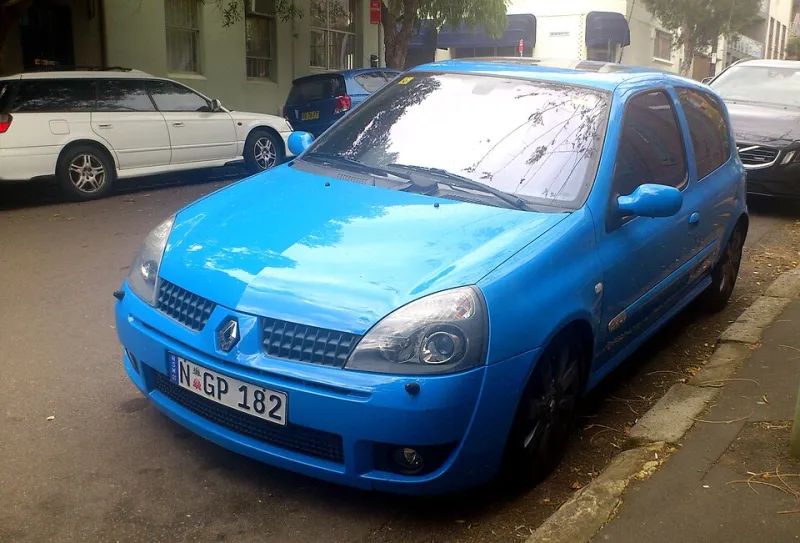
Photo: Calreyn88, CC BY 4.0, via Wikimedia Commons
There is a particular kind of dread reserved for the 8am queue at a UK track day. Helmet under one arm, tyre gauge in the other, and twenty metres ahead of you a bloke in a hi-vis with a clipboard, a microphone on a stand and an expression that suggests he has already heard quite enough Clios for one morning.
Noise testing is the least glamorous part of our hobby and the one that ends more track days than any mechanical failure. It is also, mercifully, one of the most solvable problems in French performance car ownership, provided you treat it as a setup item rather than an afterthought.
Why French hot hatches keep failing
Nothing about a 172, a Megane R26 or a 205 GTI is inherently antisocial. The problem is what we do to them. A standard Clio 172 with a factory exhaust will typically read somewhere in the high 80s at a static test, comfortably inside almost every limit in the country. Add a decat, a stainless system and a manifold, and you have effectively removed every piece of acoustic baffling Peugeot or Renault spent money developing. The same car now reads in the high 90s or beyond.
Small-capacity turbo cars make it worse. A 1.6 THP with a straight-through system produces a hard, flat, extremely loud note that carries, and turbo whistle and wastegate chatter read on the meter too. Naturally aspirated screamers have their own issue: the noise peaks right where the tester asks you to hold the revs.
Two tests, two very different problems
The static test is the one you queue for. The drive-by test is the one that catches people out.
A static test is taken with the microphone at roughly 45 degrees to the exhaust outlet, half a metre away and at the same height as the pipe. You are asked to hold around three-quarters of maximum power revs for a second or two. Fail and you either go home or get sent to a scrutineer who will look at you with enormous sympathy and no solutions.
A drive-by is measured by trackside microphones as you accelerate through a designated zone under load. This is where a car that scrapes through statically can still trigger a black flag: at wide-open throttle in third, on boost, the exhaust is doing something quite different from what it did in the paddock. Induction noise, tyre squeal and even a tired gearbox whine can contribute.
Ballpark limits for 2026
Confirm with the organiser before you book, because limits can vary by fixture rather than circuit, but these are the figures you are broadly working with:
- Bedford Autodrome - 87 dB(A) drive-by. The strictest mainstream venue in the UK and the one that separates the prepared from the hopeful.
- Brands Hatch - around 101 dB static, 90 dB drive-by.
- Donington Park - around 98 dB static, 92 dB drive-by.
- Oulton Park and Snetterton - around 103 dB static, 90 to 92 dB drive-by.
- Cadwell Park - around 105 dB static, 90 dB drive-by.
- Castle Combe - around 100 dB static, 90 dB drive-by.
- Anglesey - around 105 dB static, 95 dB drive-by.
- Goodwood - around 98 dB static, 96 dB drive-by.
- Croft - around 98 dB static, 88 dB drive-by.
If you can pass Bedford, you can pass anything. It is the standard to build to.
Fixes that actually work
Fit a dB insert. A simple baffle in the tailpipe, twenty to fifty quid, and worth five to eight decibels on a loud system. It costs you a little top-end power and a fair chunk of the sound you paid for, but it gets you on track. Carry it in the boot and fit it at the gate.
Repack the silencer. Blown packing is the single most common cause of a car that used to pass and now does not. Repacking kits are cheap and a Saturday morning's work.
Add a resonator. If you have a straight-through centre section, swapping in a resonated one is the least intrusive way to lose volume without losing the note entirely.
Think carefully about switchable valves. A vacuum or electronic valve looks like the perfect solution - quiet at the mic, vocal on the circuit. It is not a clean answer. Static tests are easy to game this way, but trackside microphones during a drive-by do not care what mode you have selected, and marshals have seen it all before. Treat a valve as a courtesy to your neighbours rather than a licence to run an unsilenced system.
Use a quiet map. If you have a standalone or a mappable ECU, a lower rev limit or a softer ignition map for the test is a legitimate tool. On a standard car, there is nothing to remap for noise.
Look at the intake side. An open cone filter on a 205 GTI or a Saxo VTS can add three or four decibels of induction roar that you cannot see when you are staring at the exhaust. Put the airbox lid back on for the test.
Point the tip away from the microphone. Sounds daft. Frequently worth a decibel. A slash-cut or angled tailpipe can be rotated, and a pipe that exits towards the kerb rather than the stand buys you a little headroom.
Which French cars walk it and which need a plan
A standard 205 GTI, C2 VTS or 208 GTI is generally fine, typically reading in the mid to high 80s. A standard Clio 172 or 182 sits comfortably under most static limits. The trouble starts with the modified ones: a decatted 182 on a race system will happily read over 100 dB, and a Megane 225 or R26 with a three-inch turbo-back is in the same territory. Clio 197 and 200 models with quality aftermarket systems are usually manageable with an insert. Anything with a four-branch manifold and no cat should be tested at home before you commit to a 5am start.
Your pre-track-day checklist
- Test the car yourself a fortnight before, not the night before
- Check the limit for the specific fixture, not just the circuit
- Have an insert, tools and a spare gasket in the boot
- Refit the airbox lid and any under-bonnet sound deadening
- Check for blowing joints and cracked welds at the manifold
- Confirm the car will hold the test revs cleanly without hunting
- Pack earplugs for the drive home, ironically
Do the test yourself
A cheap handheld sound level meter, thirty to sixty pounds, is one of the best investments a track day regular can make. Phone apps are directionally useful but wildly inconsistent. Measure at half a metre, 45 degrees, at three-quarters revs, in an open space with nothing reflective nearby, and compare the result against your target circuit with a margin of three or four decibels. If you are within two, you are gambling.
Noise testing is not the enemy of a good-sounding French car. It is just the price of admission, and the owners who plan for it are the ones still circulating at four o'clock while everyone else is loading up.