Doing Without, Paying More: The Mégane R26.R in 2026
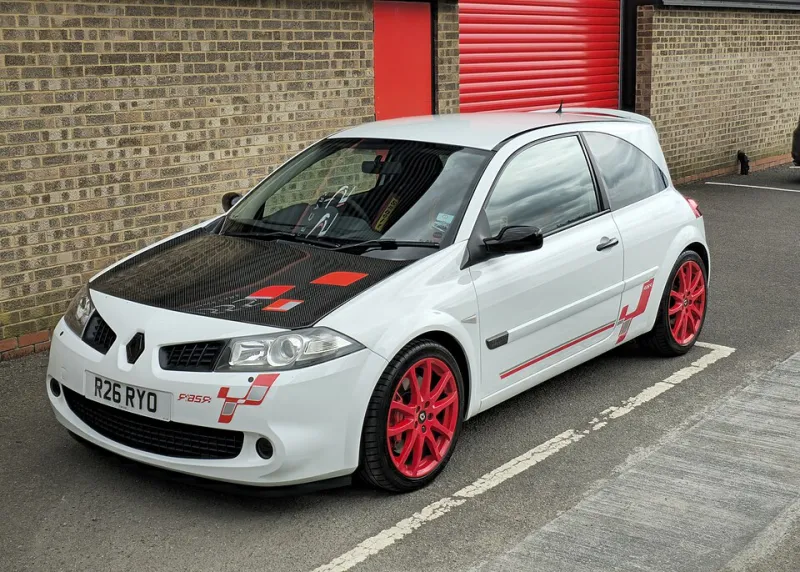
Photo: Calreyn88, CC BY-SA 4.0, via Wikimedia Commons
There's a particular kind of logic that only makes sense to Renaultsport engineers. Take a perfectly good Mégane R26, tear out the rear seats, bin the sound deadening, swap glass for polycarbonate where you can get away with it, bolt in a roll cage, and charge more for the result. In 2008 that car was the R26.R, and 450 were built — 230 of them destined for the UK. Eight minutes seventeen around the Nordschleife, the first front-wheel-drive production car under 8:20, and a template that every hardcore hot hatch since has quietly copied.
Eighteen years later the question is a different one. Not "is it brilliant?" but "is it usable?" Because the R26.R has crossed a line that the standard Mégane R.S. cars haven't. It's no longer a cheap track toy that happens to be special. It's a collector's piece that happens to have a roll cage.
What the money actually buys
The numbers still read well. 230bhp from the F4Rt 2.0-litre turbo, 1230kg on the scales, a claimed 0-62 of 6.0 seconds. But the figures were never the point. The point was the discipline — the specific spring and damper rates, the thicker rear anti-roll bar, the manual-only gearbox, the Sabelt harnesses, the Toyo R888s on unusual 17-inch wheels, and the option of a carbon bonnet with the decals deleted. It had a plastic rear screen that scratches if you look at it wrong, no aircon unless you asked, and a price tag of nearly £25,000 when a well-specced R26 was comfortably less.
In 2026, you'll pay somewhere between £45,000 and £70,000 for a decent one, and frankly the ceiling seems to keep moving. Low-mileage, unmodified, decals-intact cars are firmly in modern-classic territory. That's a lot of money for a car with no rear seats.
The case for tracking it
Here's the thing: all of that makes the R26.R a slightly worse track car than it used to be, and a slightly better one at the same time. Worse because nobody wants to put miles on a £60k Mégane. Better because the car itself hasn't changed. The cage stiffens the shell in a way that a bolt-in bar in a standard car never quite replicates. The weight loss is real, gone from the worst possible places — up high, over the rear axle, from the bits you feel on turn-in. The R888s, when you can find them, still talk to you in a way that modern semi-slicks don't bother with.
Drive one back-to-back with a standard R26 and the difference is not subtle. It turns in with an eagerness that borders on twitchy on a cold morning, then settles into a mid-corner attitude that flatters the brave and, honestly, punishes the lazy. The brakes are strong but the pedal is long by modern standards. It rewards a driver who's prepared to work the gearbox and keep the turbo on the boil.
Where it gets awkward
The practicalities are where the romance starts to fray. Parts for a standard Mégane R26 are mostly available and mostly cheap. Parts for an R26.R are not. The specific springs, the cage padding, the plastic rear screen, the carbon bonnet — all of it is either NLA or priced like it came from a Ferrari parts counter. Tyres are a faff too. The 17-inch fitment is an oddball size, R888s in the right specification are increasingly seasonal, and most owners end up running something more modern and slightly wrong because the alternative is a second mortgage.
Then there's the MOT. A caged car with harnesses and no rear seats is fine if it's done properly, but you'll want to know how the harnesses are mounted and whether the cage has been welded or bolted. And insurance — a limited-edition Renaultsport with a cage and a decal kit is exactly the sort of thing that makes underwriters nervous. Agreed value is essential, and specialist cover is not optional.
Noise is another one. The F4Rt isn't a screamer but the stripped interior and the plastic windows let everything through. Most UK track days run a 95dB static test, which the car should pass on a standard exhaust, but a tired system or a cheap aftermarket back box will get you pulled. Worth checking before you book.
The R.S. 250 argument
Here's the uncomfortable bit. A clean Mégane R.S. 250 or 265 costs a third of what an R26.R does in 2026, has more power, better brakes, a more usable chassis, and parts availability that isn't a group chat and a prayer. It's also, by any objective measure, a faster and easier track car. The R26.R's only genuine advantages are the cage stiffness, the weight, and the fact that it has a story to tell.
Which is fine — cars are emotional objects, and the R26.R is one of the most emotional front-wheel-drive cars ever built. But be honest with yourself about what you're buying. If you want the fastest lap in a Mégane, buy a 275 Trophy-R and be done with it. If you want the thing that started all this, and you're prepared to spend real money keeping it right, the R26.R still delivers a driving experience that very little else matches.
Buying notes
- Check the cage mounts and the harness bar for cracks and corrosion. It's the one job you don't want to inherit.
- Verify the decals are original. Reproduction kits exist, and while they're fine, they shouldn't be priced as original.
- Look at the plastic rear screen. If it's milky or scratched, replacements are scarce and expensive.
- Ask about the springs. If they've been swapped for standard R26 items, the car isn't quite the thing it's pretending to be.
- Get the chassis number confirmed against the Renaultsport register. Yes, people have built replicas.
- Budget for tyres and brakes annually. This is not a car that gets cheaper to run.
The verdict
The R26.R is a genuinely great car that has become a genuinely awkward one. It's still the purest expression of what Renaultsport could do, and on the right day, on the right circuit, with the right tyres, it's as satisfying as anything you can put on a UK track day. But in 2026 it asks for commitment — financial, practical and emotional. If you've got all three, it's a wonderful thing. If you haven't, the R.S. 250 is waiting, and it won't judge you.