The B-Road Runt: Why the Renaultsport Twingo 133 Still Deserves a Place on Your Shortlist
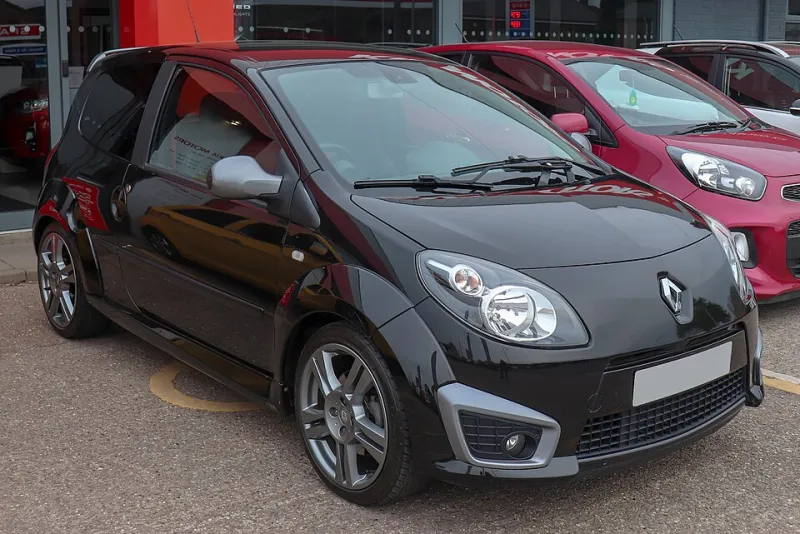
Photo: Vauxford, CC BY-SA 4.0, via Wikimedia Commons
There is a quiet hierarchy in French hot hatch circles, and the Renaultsport Twingo 133 sits somewhere near the bottom of it. Say 'Twingo 133' at a track day and you'll get a polite nod. Say 'Clio 182 Trophy' and the conversation stops dead. That's a shame, because the smallest Renaultsport of the modern era is arguably the purest thing the firm built in the late 2000s, and in 2026 it remains the cheapest way into a properly engineered French performance chassis.
The car nobody queues for
Launched in 2008 and lightly facelifted in 2012, the Twingo Renaultsport 133 was a slightly mad answer to a question Britain never really asked: what happens if you take the Twingo city car, widen the tracks, flare the arches and hand the whole thing to the people who did the Megane R26? What came back was a 1.6-litre naturally aspirated four making 133bhp, a five-speed manual, front-wheel drive and a kerb weight of roughly 1,050kg.
UK cars mostly landed with the Cup chassis as standard: stiffer springs and dampers, a quicker steering rack, uprated anti-roll bars and 17-inch alloys wearing 205/40 rubber. A softer Sport setup was a no-cost option, and there's nothing wrong with it, but the Cup car is the one that makes the argument. Renault also built a UK-only Silverstone GP edition and, later, the Gordini — mostly trim and stickers, but worth knowing if you want something a bit different at a show.
The endorsement that matters most, though, came from Gordon Murray. He bought one, used it as a benchmark while developing his own city car, and has spoken about it repeatedly as one of the great front-drive chassis. When the bloke behind the McLaren F1 rates a sub-six-grand Renault, you should probably pay attention.
A chassis that punches above its price
The Twingo's party trick is that it doesn't need power to be entertaining. The wheelbase is short, the track is wide relative to the body, and the overhangs are almost non-existent. On a tight, cambered, badly-sighted B-road — the sort that climbs out of a Yorkshire valley or snakes across the Mendips — that adds up to something genuinely quick point to point.
Where a Clio 197 or a Megane 225 has to be threaded carefully down a hedge-lined lane, the Twingo simply fits. You can use more of the road, more of the time, and you're not constantly waiting for a straight long enough to deploy power you didn't really need. Grip is strong for a car this light, body control is excellent, and the whole thing rotates neatly on a lifted throttle without ever feeling like it wants to bite you.
It is also, crucially, a car you can enjoy at legal speeds. Forty mph through a second-gear bend feels like an event. That's a rare quality in 2026, when most modern hot hatches need triple figures before they wake up.
The engine: old school, on purpose
The K4M 1.6 is not a powerhouse. Peak power arrives at 6,750rpm, torque peaks around 4,400rpm, and 0-62mph takes the better part of nine seconds. Nobody is going to be impressed by the numbers.
What the numbers miss is the way it delivers. There's no turbo to spool, no torque hole to fall into, just a linear pull that builds and builds until the needle is buried in the red. The induction rasp from behind the seats is genuinely addictive, and the five-speed gearbox has well-judged ratios for British roads — second and third do most of the work.
It's a reminder of what we lost when everything went turbocharged and downsized. The Twingo isn't fast. It is, however, always willing, and that's worth more on a Sunday morning.
What to check before you buy
The Twingo 133 is broadly tough, but there are known weak spots. Go in with your eyes open:
- Cambelt history. The K4M is an interference engine and the interval is five years or 72,000 miles, whichever comes first. Budget £400-£550 at an independent, more at a main dealer. No paperwork means assume it needs doing.
- Rear brakes. Sticking calipers and lazy handbrake mechanisms are common, especially on cars that live outside. Check for heat and uneven pad wear.
- Boot and rear light leaks. Water in the spare wheel well is a familiar Twingo complaint. Lift the carpet and have a proper look.
- Rust. Rear arches, sills under the plastic covers, and the boot floor. It's a French hatchback of a certain age — don't assume it's immune.
- Suspension wear. Top mounts, bump stops and rear bushes take a beating on UK roads. A knock over speed humps is usually cheap to fix but worth haggling over.
- Wheels. Cup 17s are diamond-cut and refurbishment isn't cheap. Kerbing is almost universal.
- Clutch and gearbox mount. The five-speed is durable but the mount perishes, and a tired clutch on a car with a light flywheel is obvious on a test drive.
Service history matters more than mileage. A well-maintained 110,000-mile car is a far better buy than a 60,000-mile one with no receipts.
What it costs to run
This is where the Twingo quietly wins. Insurance sits in a sensible group for a performance hatch, tyres in 205/40 R17 are affordable, and consumables are shared with humbler Twingos and Clios, so nothing is exotic. A cambelt, water pump and aux belt together should come in under £600 at a good independent, and brakes and servicing are Renault-cheap rather than Renaultsport-expensive.
Fuel economy in the high thirties is realistic on a mixed run, and better on a long motorway slog. For a car that will happily do a track day and then take you to work on Monday, that's a strong package.
On price, 2026 values are still firmly in bargain territory: £3,000-£3,500 buys a scruffy but usable car, £5,000-£6,500 gets a tidy Cup with history, and the best low-mileage examples or special editions are pushing £8,000. Given where Clio 182 values have gone, that won't last forever.
Where it fits in 2026
Euro 4 and Euro 5 emissions mean the Twingo is fine for London's ULEZ and the various clean air zones, so it isn't going to be priced off the road any time soon. It's small enough to park in a city, cheap enough to insure for a younger driver, and interesting enough to stand out at a French car meet.
It will never have the cult following of the 182 Trophy, and it doesn't have the outright pace of a Megane R26. But as a pure, uncomplicated, affordable French performance car that you can actually use every day, the Twingo 133 makes a very persuasive case — and it's still the one nobody is queuing for. That's exactly why you should.